
Looking for the “Perfect Level” Resource
Some Thoughts on Comprehensible Input, Effectiveness, and Enjoyment

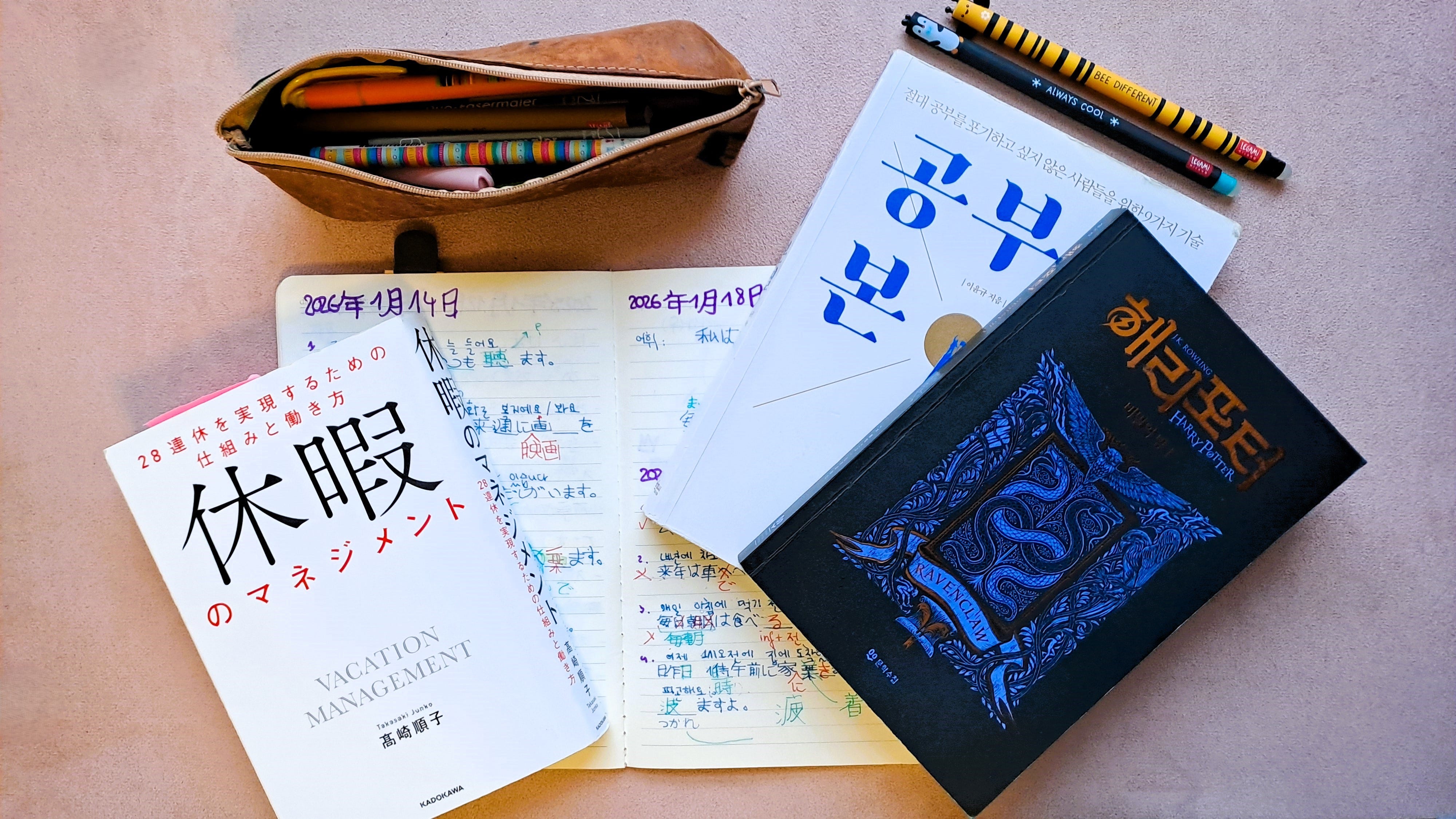
Comprehensible input, a well-known concept in the language-learning community
If you are learning a language and are even just a little active in the language-learning community, you have probably already heard about it: one of the hottest topics—and one that is often considered one of the most important aspects of language learning—is comprehensible input. The core idea is that we progress most effectively when we engage with content that is slightly above our current level—challenging enough to push us forward, but still understandable. If it’s too easy, we don’t learn much; if it’s too hard, we struggle to learn at all.
While the purpose of this article is not to question the validity of this concept – I am not qualified in that field, nor have I read enough studies on the topic – I’d rather like to bring another thought into the discussion—one that I personally don’t see very often.
Looking for the perfect and most effective content
Sometimes, I feel like we—and I include myself here—spend a lot of time trying to find content that is perfectly adapted to our level. And when we don’t find that optimal material, we feel limited in what we can do. Rather often, we feel unable to start learning, reading or listening because we haven’t found the right resource. This may be particularly applicable to languages or dialects with fewer available resources, such as graded readers or content created specifically for language learners.
Do we always need the perfect resource to be able to learn?
While theories such as comprehensible input can be highly interesting, and it is great that research is becoming widely available, I also believe that when a concept becomes popular and mainstream, it can limit our ability to think outside the box.
That’s why I’d like to bring the following question into the discussion:
Do we really need perfect resources that match our level in order to learn, improve and enjoy learning a language?
In the following section, I would like to share how I sometimes work with the materials I have at hand, regardless of whether they are ‘at my level’ or not.
Story time: my baby steps in Japanese
While this example comes from my experience with Japanese, the approach itself is not specific to any one language.
I started learning Japanese last year in May, taking it slowly but steadily and enjoying every little step. I am still at a very beginner level, able to understand very easy texts such as graded readers (levels 0 or 1 on Tadoku), short stories for beginners (on Yomu Yomu), or short animation videos made for learners (like those on Japarrot). I also started writing my own very simple sentences using kanji I know a few weeks ago. It has been genuinely rewarding to see my slow progress, and I really enjoy the fact that I am not rushing. I’ve always valued the process itself—sometimes even more than the results.
A few years ago, my father was interviewed by a Japanese author about the holiday system in France. As a thank you, the author gave him a copy of the book that was published later — a book entirely in Japanese, of course. The last time I was at my parents’ house, I took the book home with me.
Since I started learning Japanese, one thing I’ve been loving is using that book to study. Needless to say, the content is not matching my level at all. It is a highly advanced book, dealing with complex topics such as the vacation system, retirement, businesses, and social policies.
Learning beginner Japanese with an advanced resource
Of course, I cannot read the book. If I tried, I’d probably understand at most 0.1%. So, “What are you even doing with it?!” you might ask.
Well… quite a lot, actually.
Here are a few examples.
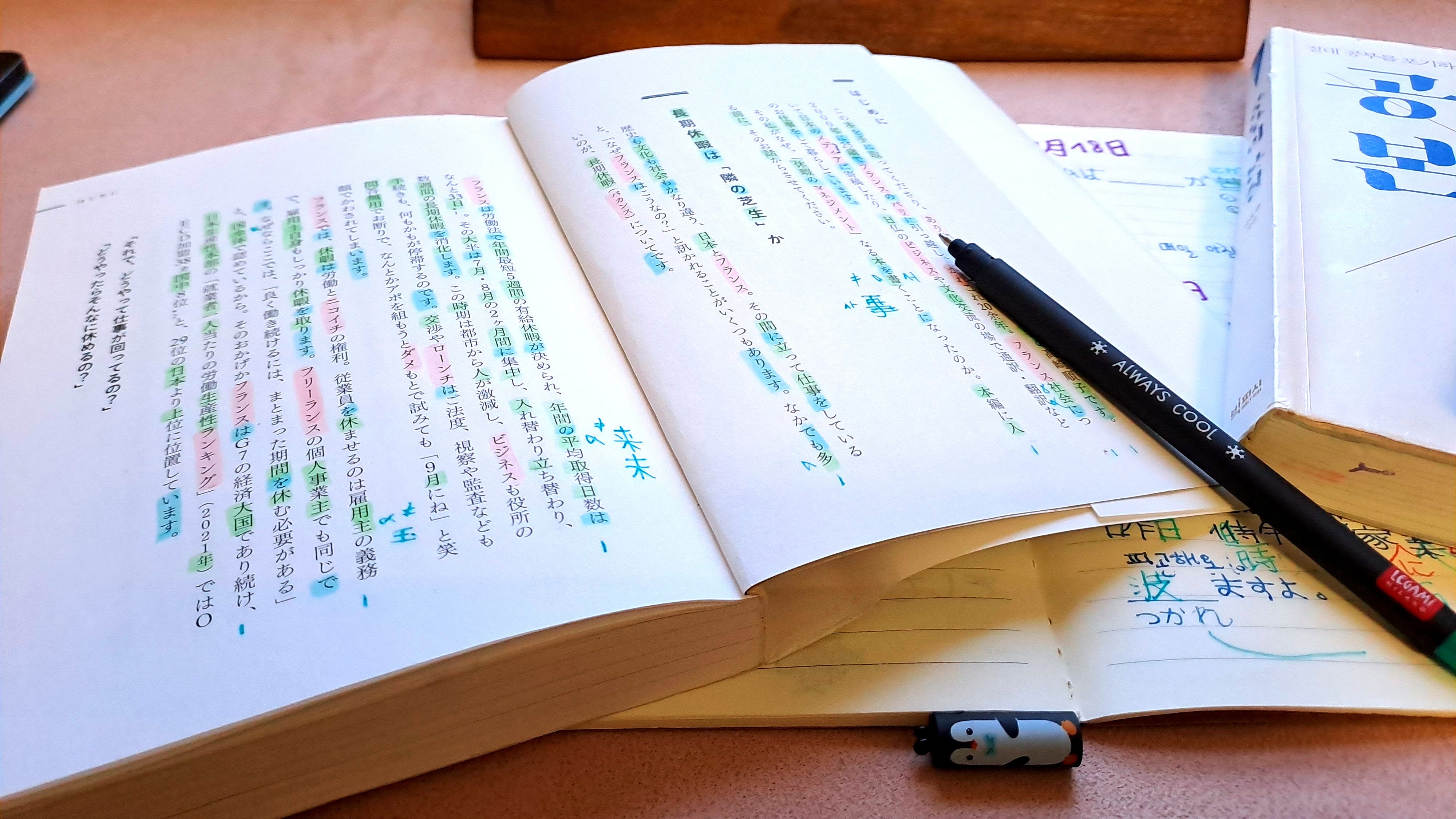
1. Recognising kanji
One of my favourite ‘games’ to play with that book is to pick a random page and highlight all the kanji characters that I recognise. I look through the page to see if anything looks familiar. If I recognise a kanji, I try to think of a familiar word that uses it and/or recall the reading(s) I already know.
Sometimes, some kanji look very similar. In that case, I love looking them up in the dictionary and placing them side by side. It helps me see the differences more clearly. Sometimes I notice that I missed a kanji I had actually learned before but couldn’t recognise in context. When that happens, I mark it down, which helps me identify which kanji are not fully memorised yet. Just doing this already made them much easier to remember.
And sometimes—purely out of curiosity—I look up the meaning of kanji I haven’t learned yet and that are way too complex, but simply look fun. Especially when a complex kanji is made up of simpler ones, it’s surprisingly enjoyable to try to guess its meaning by looking at its components.
2. Recognising grammar patterns
Another similar “game” I often play is focusing on grammar patterns. I usually highlight grammar patterns in a different color, trying to recall what they are used for. When I see the same pattern popping up again and again, I sometimes pick it and research its meaning.
Sometimes it turns out to be way above my level—but sometimes, surprisingly, it ends up being a more basic pattern that I have already learned.
3. Reading out loud
Even though I have to skip almost all the kanji, I can still read the kana out loud. This is a fun way to practice my pronunciation and to make sure I don’t forget how each kana is pronounced.
Since the book talks about vacation systems and corporate structures in France, there are quite a lot of katakana (the script used for foreign words), which makes it great practice. While I feel confident with hiragana now, some katakana characters are still not firmly set in my mind. Reading out loud helps reinforce them.
Six years and hasn’t been boring once
Playing with this book this way made me personally realise that I don’t necessarily need to fully understand a resource for it to feel meaningful or enjoyable to work with.
Using a resource that is far above our level is probably not the most effective learning method in a strict sense. However, I would argue that having fun and engaging with the content we already have on hand—whether it perfectly matches our level or not—can be incredibly valuable in the long run.
When I look at my own language-learning journey, I can clearly see that when I enjoy the process, I naturally end up spending more time learning—no matter how imperfect the method or the content may be for me. With Korean, this approach worked. It has been almost six years since I started learning it, and I’ve loved the process the entire time. It was never boring, and I never felt like quitting—not even once.
An Invitation to Let Go and Enjoy
I’d like to close this article with a few final words. In a society where effectiveness and productivity are highly valued, we—including myself—can sometimes end up performing our hobbies instead of enjoying them for what they are. We start learning a language for fun, and without even realising it, we spend hours watching videos or reading articles about the perfect learning method, trying to optimise our approach to be as effective as possible. Sometimes, we even force ourselves to use methods we don’t actually enjoy, simply because they are “stamped” as the best.
I’d like to plead for a bit more innocence and pure enjoyment. For letting go of methods and productivity, and simply doing whatever we feel like doing in the language—regardless of the results, regardless of whether it is effective or not. If learning a language is a hobby, why should we force ourselves to do things we don’t truly enjoy?
Maybe the question isn’t so much whether we have the perfect resource, but whether we allow ourselves to engage with the language in ways that feel alive to us right now.
What about you?
What about you? What have you been wanting to do in your target language but didn’t allow yourself to try because it felt not adapted to your level yet? I’d love to hear your thoughts.
I love this Curlyrise 🤩. I always fall into the trap of trying to be more productive and forget to enjoy learning. Even though I know that when I enjoy studying, I tend to learn more easily and effectively without being intentionally so. Because I am simply enjoying it.
Despite using a resource far above your level, just because you set your intentions and goals for this, you are enjoying and learning without feeling overwhelmed. And this is the secret.
That was really inspiring and motivating me to reassess how I approach my study sessions.
Thank you for sharing!
I'm learning Japanese and was stuck in between beginner material, that feels boring, and intermediate material, that feels out of reach. So just like you I decided to use the more motivating contents (intermediate) and find ways to use it although "I don't have the level" yet. Lately I've been busy with sentence pattern recognition and I'm reading a story I like, although the vocabulary is really difficult.