
Overcoming the intermediate plateau in speaking
How I decided to push it to the next level

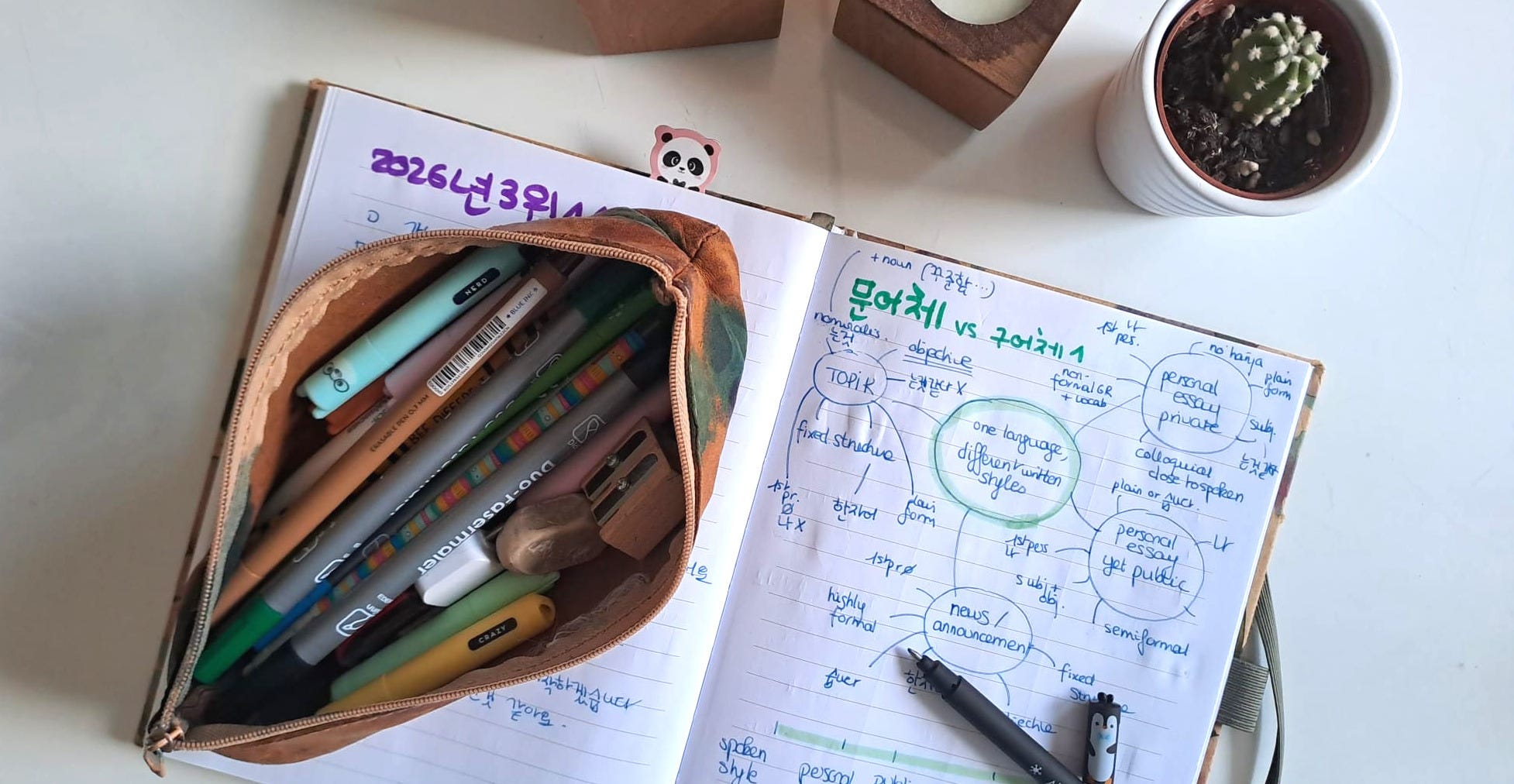
When the journey unfolds naturally
Throughout my language journey, I have always let my intuition take the lead. I purposely never set goals, nor did I try to find the most effective way—if there even is one. My motto has always been to follow my gut feeling, focusing on what brings me joy in the present moment. Now, as I look back at my Korean journey so far, I can clearly see how each year has naturally unfolded. It’s fascinating to see how my journey seems to have followed its own pace, each year bringing a new focus.
I started learning Korean back in 2020, and after about two years, I moved beyond the beginner phase and reached a low-intermediate level in 2023, where I could express myself more easily. While 2024 was the year of listening—thanks to podcasts like the one from the amazing Didi1—2025 ended up being the time when I dived deeply into reading, naturally boosting my reading skills2.And this year, once again, I can feel how the need to focus on another area is growing day by day.
The need to push it to the next level
It’s been there for a while now. Although I am confident for the most part when it comes to listening to podcasts and reading novels, I have the urge to become more accurate when I speak and write. Just like I did at the very beginning of my Korean learning journey, I decided about six months ago to—once again—focus more on practising my speaking, through language exchanges and even a one-to-one conversation class with a teacher on Italki.
While this has helped my speech flow more easily, as well as acquire and actively use new vocabulary, it has also made me realise that I am stagnating in other areas, such as the use of more advanced grammar patterns and sentence structures. I guess the reason is that at the intermediate level and above—when it comes to conversation or writing—even if we lack vocabulary or don’t know the exact grammar, we can still work our way around it, and it will sound perfectly fine. And that’s probably the problem (and the opportunity!). It makes it harder to step out of our comfort zone, stop relying on the same basic grammar patterns and words we are confident with, and actually push ourselves to the next level.
The intermediate plateau
I guess this is what some call the intermediate plateau. I have noticed how this term is often associated with stagnation. For me personally, it’s a mix of slight frustration and a huge amount of excitement at the same time. Frustration because I can’t yet speak and write the way I know I could. Excitement because the advanced level doesn’tseem to be that far away aynmore. And somehow, that combination feels like an opportunity to bring a breath of fresh air into my learning journey3.
Without this, would I feel the urge to rethink the way I am currently learning Korean? Would I have the need to push further instead of staying in my comfort zone? In my opinion, it is exactly this feeling that has been naturally a motor, pushing me to look at my current approach and adjust it to match my new needs. For sure, 2026 will be the year I focus on becoming more accurate and bring my writing and speaking to the next level.
Creating my own virtuous circle
In the past few years, I have been in a phase of expansion: listening and reading a lot to increase my comprehension and vocabulary, and practising speaking regularly with friends. Now, the time has come to take the opposite direction and narrow my focus. I have a strong need to shift my attention towards precision, accuracy, and quality. To be able to do so, I have reflected quite a lot and come up with a new approach for myself. This is how I am currently studying.
1. Analysing
During this step, I look back at texts I have written or recordings of my one-to-one lessons and language exchanges. I analyse them systematically to identify my weaknesses. I am also considering asking my teacher for general feedback on my skills, since she has now taught me for around ten lessons and could provide a valuable external perspective. For me at this stage, it’s not about identifying specific mistakes, but about understanding broader patterns and areas I need to work on. I keep a dedicated page in my notebook for these observations and update it regularly.
2. Targeted exercises
During this step, I work on my weaknesses through targeted exercises. For example, I noticed that I tend to mix different registers, which leads to a lack of consistency. So I started working on that. One exercise I use is writing the same text twice: once in a semi-formal tone and once in a formal tone. I then use the website Journaly4 to get feedback from native speakers. Another example: when I notice that I rely too much on the same basic grammar patterns, I take those specific sentences using this pattern and try to find alternatives. Sometimes I also create mind maps of similar grammar structures to better understand the nuances and have a better global understanding of them. Writing lists of synonyms is another way I try to avoid repeating the same words again and again.
3. Output
The final step in my personal routine is regular output: one-to-one conversations with my teacher, language exchanges with friends, or writing essays from time to time. Just like I have been doing the past months. At this stage, it’s not about targeted exercises, but about using the language more freely. I then reuse that output as material for… the very first step: analysing.
One (or two) last thoughts
Writing as a bridge to better speaking
While I have the need to work on my output in general—both writing and speaking—I have come to the conclusion that I want to focus even more on writing. At this stage in my language journey, I have the feeling that improving my writing will significantly improve my speaking at this intermediate stage. Writing is less forgiving than speaking and gives more time to work on sentences, vocabulary, and weaknesses. That is why I believe writing practice could be a real game changer when it comes to speaking at a more advanced level.
My forever motto: Flexibility and Fun
Because I strongly believe that flexibility and enjoyment are key to long-term language learning, I do not follow a fixed schedule. I haven’t—and don’t want to—decide in advance when and how long I should spend on each step. I simply move on when I feel like it. For the same reason, I don’t know how long I will follow this approach. I will continue to trust my intuition. I never committed to learning Korean long-term either, and I believe that this is exactly why I have been able to stay consistent—always being excited about every small step. I want to keep that mindset this time as well.
But what about you? Where are you in your language journey right now? I would love to hear how you’re navigating it and what your mindset is like.
More about Didi Korean Culture Podcast on YouTube. She has a variety of podcasts including current news presented in a way that is easier to understand. This serie is called 할말 이슈.
You can read more about my (Korean) reading journey in my last Substack article here:

It is important to enjoy the journey, not learning a language just to speak it.
I often wonder how you're supposed to balance all 4 language learning skills at the same time and not have half the skills lag significantly behind the other half. But hearing you share about your overarching themes (2024 was for listening, 2025 was for reading, 2026 is more refinement in speaking/writing) was a good reminder for me that...maybe having all 4 skills equally advance at the same time is not necessary. It is *a* way but not *the* way. And there are probably seasons in language learning just like there are seasons in life. I usually don't force myself to manage all 4 skills but I still feel some type of way about not being able to do so, and your article reminded me to take it all more light-heartedly, and intuitively. Love the virtuous cycle. Thank you for the article. I can't wait to hear about how your approaches continue to evolve over time! 🥰